
 It might seem like a minor question. But for those of us who work with brands, it’s not.
Because a single word has become the name under which practically an entire sector gathers.
And this week we’ll see it again in Madrid, which will bring together more than 2,500 companies, 121,000 professionals from over 150 countries, and occupy 10 pavilions at IFEMA Madrid. This scale confirms the extent to which the fruit and vegetable sector has become a global, sophisticated, innovative, and extraordinarily competitive industry.
Behind a fruit or vegetable, there’s much more than what we see when it arrives on our table.
There are farmers, land, science, and genetic research.
There’s varietal innovation, technology, water efficiency, and logistics.
There are cooperatives and companies, exports, distribution, and retail.
There are entire generations of accumulated knowledge.
There’s food, health, and life.
Spain has learned to do many of these things exceptionally well.
That’s why, during Fruit Attraction, we find it particularly interesting to ask another question:
Are we managing to translate all the value generated by the sector into the same level of value perceived by the market?
Because producing better doesn’t guarantee being chosen more. Innovating more doesn’t automatically mean being more distinctive.
And having an excellent product doesn’t guarantee capturing all the value behind it either.
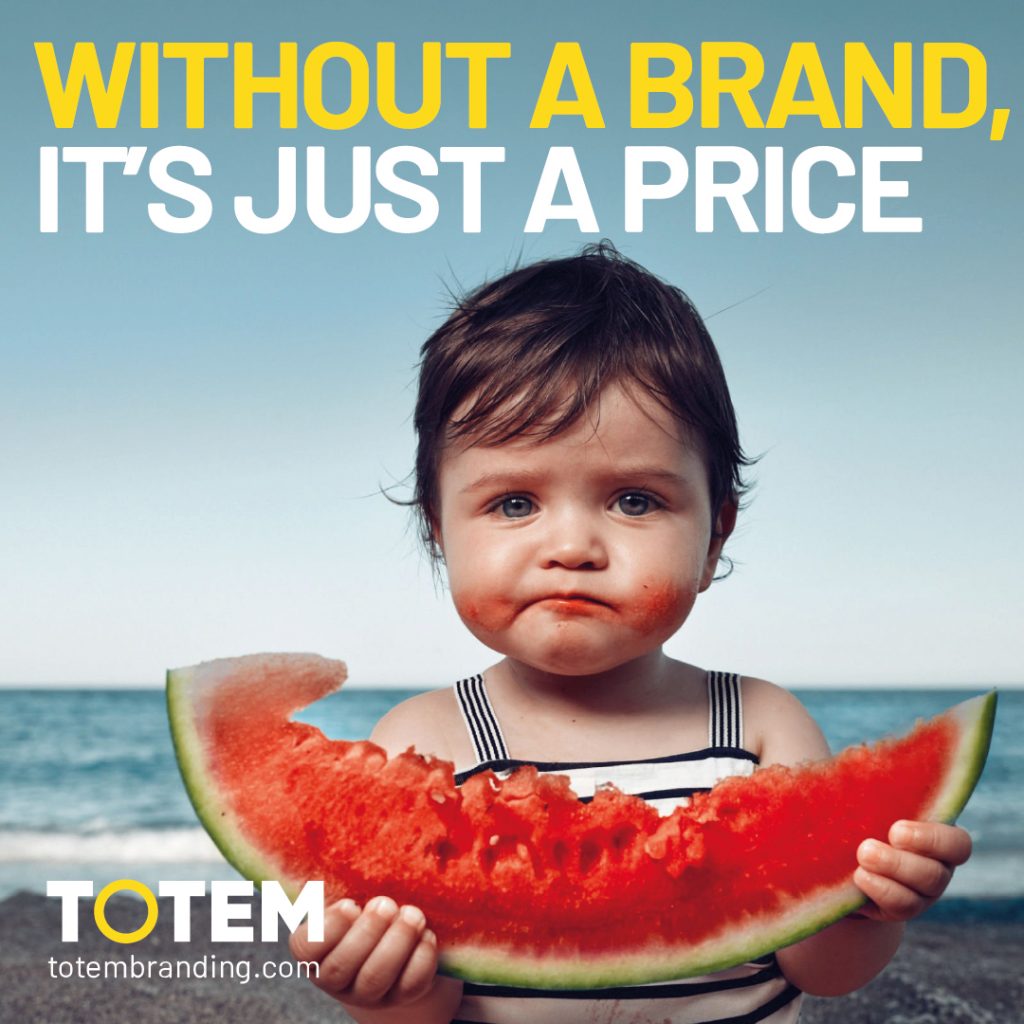
When the market fails to sufficiently perceive the differences between two products, two cooperatives, or two companies, the conversation usually ends up shifting to the area with the least margin: price.
Our CEO, Andy Stalman, sums it up very directly: “A fruit and vegetable company without a brand is a commodity seller.”
At TOTEM Branding, we’ve been working precisely on this issue for years.
We’ve done so on five continents and from very different positions in the value chain: with multinationals, family businesses, cooperatives, industry associations, distribution, and retail.
And within the agri-food sector, we have supported organizations such as TROPS, Campofrío Frescos, INTERPORC, and the Valle del Jerte Cooperative Association, among others.
Experience has taught us something important: there isn’t just one branding problem in the agri-food sector.
For a cooperative, the challenge might be transforming decades of knowledge, thousands of farmers, a vast territory, and enormous production capacity into a recognizable and distinctive proposition.
For a food company, it might involve updating its positioning in the face of evolving consumer habits and categories.
For an industry association, it’s about building a narrative capable of representing and projecting an entire industry.
For an exporting company, it’s about ensuring that what makes it different remains understandable and relevant when it crosses borders.
For distribution and retail, it’s about transforming product, experience, and value proposition into preference.
These are different challenges, but they all ultimately lead to a very similar issue. How do we ensure that all the value an organization generates is also recognized, understood, and preferred by the market?
That’s where branding ceases to be merely communication.
Branding also speaks to margin, profitability, differentiation, reputation, market access, relationships with distributors, talent attraction, and the ability to be chosen.
And the fruit and vegetable sector starts from a privileged position.
Because it doesn’t need to invent a story. It already has one.
It’s in the fields, in those who cultivate them, in the origin, in innovation, in technology, in how water is used, in how the land is cared for, and in everything that happens before a fruit or vegetable reaches us.
The challenge lies in ensuring that all of that doesn’t become invisible when it reaches the market.
Perhaps there’s something particularly symbolic about a fruit and vegetable trade fair becoming Fruit Attraction on a global scale.
Good brands do precisely that. They simplify a vast reality until a single idea can represent it.
This week we’ll be listening, learning, sharing, and talking with a sector that has tremendous value to continue building upon.

